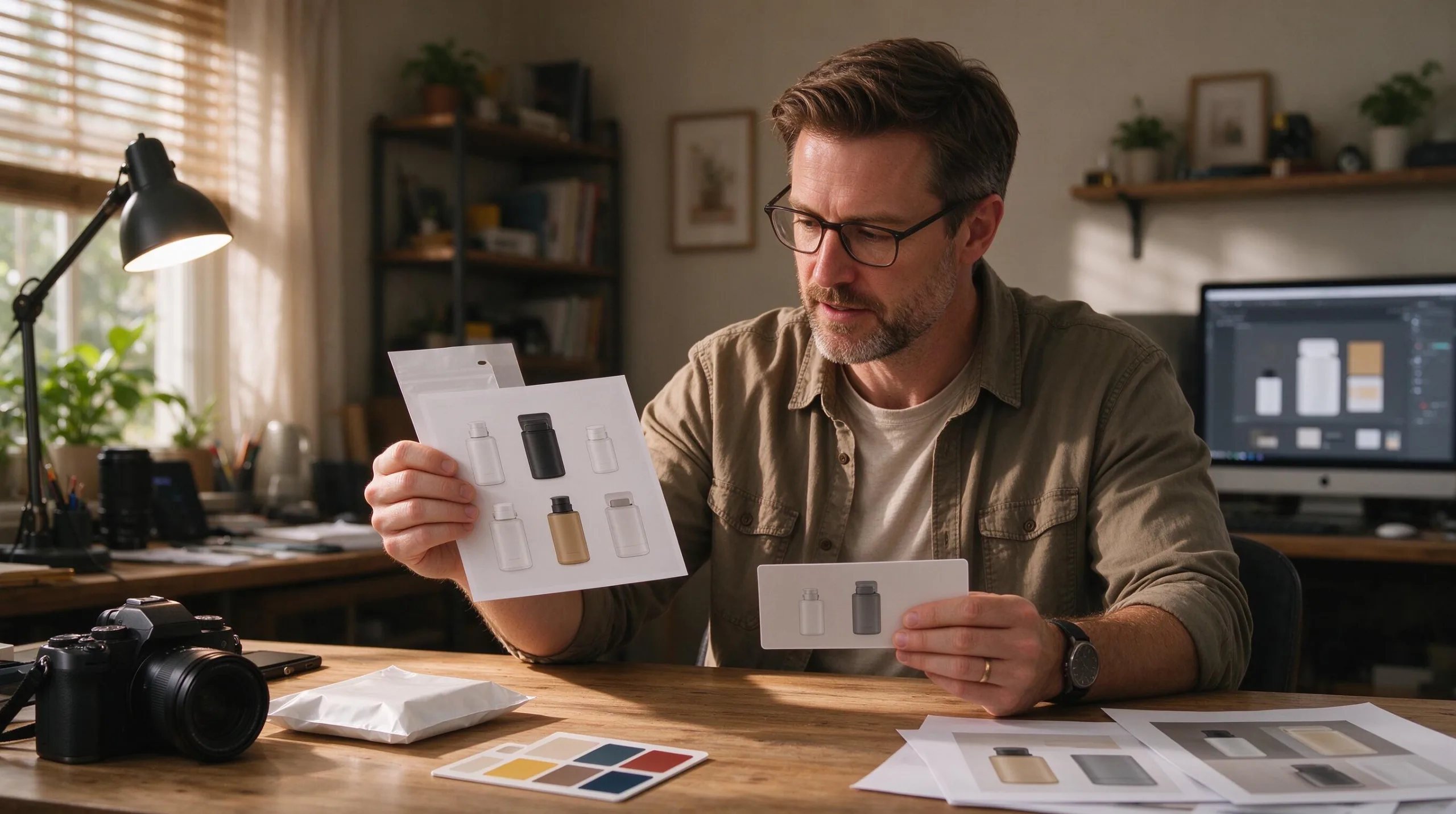
One approved hero image is a starting point, not a content calendar. A week of campaign variations requires that single successful frame to stretch across platforms, mild contextual shifts, and the inevitable “can we try it with a different prop” notes—without the product or character quietly becoming a different object. I built a complete variation system around one locked hero using Gemini Nano Banana 2.1, documenting every controlled edit, every continuity check, every client-note simulation, and every hand-off that turned a single frame into seven days of coherent assets. The process is deliberately slow at the locking stage and deliberately fast once the identity markers are protected. That rhythm is what separates a usable campaign set from a collection of pretty but unrelated frames.
Locking the Hero Before Any Expansion
The Non-Negotiable Base
The hero was a product-focused frame that had already survived identity QA: correct geometry, stable material response, clean negative space, and lighting that matched the brand’s quiet morning aesthetic. No variation work began until that base was protected and duplicated. Working from an unlocked or merely “pretty” frame guarantees that every subsequent edit inherits unresolved problems. I treat the locked hero the same way a traditional art director treats the approved hero shot from a studio day—everything downstream is measured against it, not against a moving aesthetic preference.
Variation Matrix Designed for Real Platforms
The matrix covered a realistic seven-day social cadence for a small consumer brand:
Monday: square feed hero (the locked base itself)
Tuesday: vertical Stories crop, same lighting and surface
Wednesday: mild surface change (oak to linen) while protecting product identity
Thursday: single non-competing prop addition
Friday: cooler light temperature, identical composition
Saturday: tighter detail crop focused on the product’s distinctive features
Sunday: wider lifestyle-adjacent frame that still keeps the product as the clear hero
Each cell in the matrix was written as a single-variable request wherever possible. Compound requests were deliberately avoided until the system had proven it could protect identity under simpler pressure.
Protection Language That Traveled With Every Request
Every instruction opened with the same locked markers: “Keep product geometry, label hierarchy, material response, and scale relationship to frame identical. Change only [one variable].” This repetition is not elegant, but it reduces cumulative drift compared with free-form variation prompts. I also kept a short identity board—five call-out crops of the critical markers—open beside the generation interface so every new frame could be checked at a glance rather than by memory.
Why the Locking Stage Feels Slow on Purpose
Spending extra time at the hero stage feels inefficient when a content calendar is waiting. It is the opposite. Every minute spent confirming geometry, material, and negative-space logic at the start prevents hours of later rework when a client notices that Thursday’s bag no longer matches Monday’s. The locking stage is where commercial discipline is either installed or abandoned.
Executing the Variation Sequence
Platform Crops First
Square-to-vertical and square-to-wider crops were executed as controlled reframes. As expected from earlier tests, the model occasionally reinterpreted composition rather than performing a strict reframing. Exact platform dimensions, safe-zone margins, and negative-space proportions were therefore finalized in a layout tool. The generation stage supplied the correctly lit product under the approved lighting; the design stage supplied delivery precision and platform compliance. Treating the crop step as a hybrid process—model for lighting continuity, design tool for pixel accuracy—kept the set coherent without forcing the model to solve problems it does not yet solve cleanly.
Environmental and Prop Variations
The surface change (oak to linen) and the single-prop addition produced usable results when the protection language remained strict. Both frames were verified side-by-side against the Monday hero at 100 percent zoom on the five locked markers. Minor reflected-light shifts appeared on the lower third of the product; these were corrected with a quick local adjustment in the design file rather than a new generation. The cooler-light request on Friday held geometry cleanly and became one of the strongest secondary frames in the set, confirming that light-temperature changes remain among the more stable single-variable operations.
Detail and Lifestyle-Adjacent Frames
The tighter detail crop on Saturday required careful instruction to avoid the model inventing new surface texture or softening distinctive edges. Explicit language—“preserve exact edge treatment and material response, change only the crop tightness”—kept the result inside acceptable limits. The wider lifestyle-adjacent frame on Sunday was the highest-risk cell in the matrix. Broader environmental language naturally invites more drift. Success came from keeping the product markers rigidly protected and treating the new environment as secondary context only. Even then, a small scale compensation appeared and was restored in the design tool before the frame entered the final set.
Sequencing Matters More Than Individual Quality
Generating the variations in calendar order and checking each one against the running strip of previous days revealed drift that isolated evaluation would have missed. A frame that looked excellent on its own could show progressive softening of a shoulder curve or label spacing once placed in sequence. The strip became the primary QA instrument for the entire week.
Continuity QA Across the Full Week
Daily Side-by-Side Strip
At the end of each variation the new frame was placed in a running horizontal strip beside the original hero and all previous days. This simple layout made cumulative softening visible before it became a client problem. Two frames that looked acceptable in isolation were rejected once the strip revealed progressive loss of a distinctive edge treatment. The strip also served as a quick visual briefing tool when a second designer joined the review.
Client-Note Simulation Mid-Week
On the fictional Thursday a note arrived: “Love the prop version—can we see it with the prop removed and a slightly warmer light?” The dual request was deliberately split into two single-variable steps rather than issued as one compound instruction. First the prop was removed under strict protection language; then the light temperature was warmed on the resulting frame. Identity survival improved markedly compared with earlier tests that had used compound aesthetic language. The exercise confirmed a working rule: when a client note contains more than one change, break it into sequenced single-variable requests and verify after each step.
Final Set Coherence Score
Of the seven planned variations, five passed a strict identity check after light design-tool finishing. One required moderate geometry restoration. One was replaced by a safer controlled edit that stayed closer to the locked markers. The delivered week felt like a continuous campaign rather than seven related but distinct products. That coherence is the actual deliverable; individual frame beauty is secondary.

Scaling the System for Ongoing Content
Template the Protection Block
The same opening protection language can be saved as a reusable instruction block. New variations then require only the single-variable clause. This small operational habit reduces both prompting time and identity failures. Over multiple campaigns the block becomes part of the studio’s internal language, the same way a lighting setup or a retouching preset becomes standardized.
Know the Safe Variation Budget
Under current model behavior a single locked hero can reliably support a handful of narrow environmental, lighting, and prop changes before cumulative drift demands either a new hero generation or heavier design-tool intervention. Planning content calendars around that budget prevents last-minute continuity crises. For a typical small-brand social week I now treat five strong variations as the comfortable ceiling and anything beyond that as a signal to generate a fresh hero under the same identity rules.
Hand-Off Rhythm That Protects Speed
Generation and controlled edits supply the visual ideas and lighting continuity. Design tools supply exact crops, final color matches, any required text, platform-safe margins, and file prep. Keeping that division of labor explicit prevents the common slowdown of trying to perfect delivery specs inside the generation interface. The moment a request becomes about pixel-level accuracy or brand-guideline compliance, the asset moves. Lingering inside the model past that point usually costs more time than it saves.
When to Generate a Fresh Hero Instead of Extending
If mid-week client notes begin to compound—new wardrobe, new season, new emotional tone, new product angle—the cost of protecting the original hero rises sharply. At that point the disciplined choice is to lock a new hero under the updated constraints and begin a fresh variation matrix. Extending a hero past its safe budget produces diminishing returns and rising identity risk. Recognizing that threshold early is part of the commercial judgment the tool cannot supply.
One strong hero image can become a coherent week of campaign variations when every expansion is treated as a controlled, single-variable test against locked identity markers. Gemini Nano Banana 2.1 accelerates the exploration of light, surface, prop, and crop. The set that actually ships is the one that never lets pretty variations outrun continuity discipline. Start with the brief, lock the hero, change one thing at a time, verify against the running strip, and hand off the moment precision matters more than speed. Pretty is still only the beginning of the test. A week of assets that still look like they belong to the same visual system is the finish line that counts.
For AI tool features, rules and availability, refer to their official sites.
Leave your thoughts here, too.